My Type 1 Diabetes Genomic Analysis Report
Reanalyzing my genome with DRAGEN 4.4 to better understand the genetic component of my Type 1 Diabetes.

⚡ TL;DR
DRAGEN 4.4 gave me a more accurate HLA call, and my new Type 1 Diabetes Genomics Report makes it super easy to understand my HLA / Variants Risk.
🎯 The Goal
As someone with Type 1 Diabetes who also works in the genomics industry, I have a deep fascination with the genetic component of my Type 1 Diabetes.
I am lucky enough to have had my own genome sequenced and have had a first pass at trying to interpret my own genome.
In summary, my initial analysis focused on just the HLA component of my genome, a region relevant to auto-immunity.
But my initial analysis left me stumped. I had a very unusual set of HLA genes that made even less sense considering I had Type 1 Diabetes.
And what about other important variants related to type 1 diabetes, not just HLA?
Unlike diseases like sickle cell disease, which are a single letter change among 3 billion nucleotides, diseases like Type 1 Diabetes are surprisingly more complex.
I knew as the technology and research got better, there would be more I could learn from my own genome.
For that reason, I have been looking forward to re-analyzing my own genome, and making it easier to understand my own results.
This post will go over my attempt at re-analysis, the open source repository I published to generate the type 1 diabetes genomics report, and what I think could be next.
View the Demo Report | GitHub Repository
Note: This is a follow-up to my 2023 post where I first explored my genome looking for T1D variants. This time I looked at more than just HLA, and built something that produces a comprehensive report.
🆕 What’s New in DRAGEN 4.4
When I first analyzed my genome a few years ago, I used an older version of DRAGEN. DRAGEN 4.4 brought some significant improvements, and I also enabled more features on this re-analysis:
Note: I help work on Dragen, so I am extremely biased on how awesome it is. Opinions here are my own.
- Better Variant Calling - Continued improvements to the variant caller
- Nirvana - This re-analysis enabled Nirvana, which adds “translational research-grade annotation of genomic variants”
🔬 What the Tool Analyzes
HLA Risk Assessment
- Parses DRAGEN’s HLA typing output
- Identifies high-risk haplotypes (DR3-DQ2, DR4-DQ8)
- Identifies protective alleles (DQ6, DR15)
- Calculates odds ratios based on published research (Erlich et al. 2008)
- Examines HLA Typing Confidence by parsing DRAGEN HLA Caller EM algorithm output
Here’s what my HLA results look like:
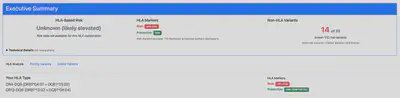
My genotype shows DR4-DQ8 on one chromosome and DR13-DQ6 on the other. The DR4-DQ8 is a known high-risk haplotype, but I also carry a protective DQ6 allele.
Non-HLA GWAS Variants
Beyond HLA, there are 25+ validated SNPs from genome-wide association studies that contribute to T1D risk. These include genes involved in:
- T cell signaling (PTPN22, CTLA4)
- Insulin expression (INS)
- Regulatory T cell function (IL2RA)
- Viral RNA sensing (IFIH1)
- Cytokine signaling (SH2B3, TYK2)
The tool checks each of these variants in my VCF. My first analysis did not look at these variants at all. So this is a big upgrade.

📊 My Results
Highlights
- 14 of 25 known GWAS risk variants present
- HLA Risk Category: Unknown (my specific DR4 subtype *04:07 lacks published data!)
- Updated HLA Call
Notable Findings
HLA Missing Piece
In my original 2023 HLA post, I had DQ8 but I appeared to be missing the DR4 gene that usually pairs with it.
| Gene | Old Analysis | New Analysis |
|---|---|---|
| DRB1 | DR13 + DR13 | DR4* + DR13 |
| DQB1 | DQ8 + DQ6 | DQ8 + DQ6 |
With the new version of DRAGEN, it seems I do have DR4 (Specifically DRB1 *04:07)! The Dragen 4.2 EM Algorithm showed uncertainty across multiple DR4 subtypes, but 4.4 resolved this definitively. Now with the ambiguity resolved, I can see a more sensible result!
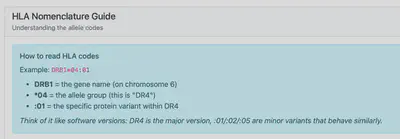
Quick note on the nomenclature, because I always think it’s super confusing:
DRB1 (gene)
 └── DR4 (serological group = all DRB1*04:XX alleles)
      ├── DRB1*04:01
      ├── DRB1*04:02
      ├── DRB1*04:03
      ├── DRB1*04:04
      ├── DRB1*04:07  ← mine
      └── ... many more
 └── DR13 (serological group = all DRB1*13:XX alleles)
      ├── DRB1*13:01
      ├── DRB1*13:02  ← mine
      └── ...
# DRB1 is the gene, DR4 or DR13 represent the serological group, and the number represents the allele.
But not so fast!
While having DR4-DQ8 usually means higher risk, my specific DR4 (DRB1*04:07) subtype isn’t in the literature.
So that is why the report says my HLA Risk is Unknown!
The risk is likely elevated, but the literature doesn’t have precise numbers.
The Takeaway
The Dragen HLA Caller is getting even better, but the research still needs to catch up on explaining what my specific subtype even means.
PTPN22 (rs2476601)
I’m heterozygous for the R620W variant. This is one of the strongest non-HLA risk factors for T1D. The risk allele is relatively rare (~4% in Latino/Admixed American populations), but I carry one copy.
What it does: PTPN22 regulates T cell receptor signaling. The risk variant causes a gain-of-function, reducing the activation threshold for T cells - potentially making it easier for autoreactive T cells to attack beta cells.
INS (rs689 and rs3842753)
I’m homozygous for both INS risk variants.
What it does: The INS gene variants affect insulin expression in the thymus, which is where immune cells learn what’s “self” vs “foreign.” Lower thymic insulin expression may reduce immune tolerance to insulin - a key autoantigen in T1D.
Protective DQ6
On the positive side, I carry DQB1*06:04 (DQ6), which is associated with protection against T1D. It is interesting to have both protective HLA genes and HLA genes that confer risk.
📖 Open Source Type 1 Diabetes Genomics Report
The report includes several features to make the data easy to understand (for myself, and anyone else who ever runs the report):
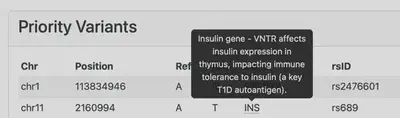
Gene Function Tooltips
Hover over any gene name to see what it does:
HLA Nomenclature Guide
HLA naming can be confusing. The report includes an expandable guide:
🛠️ Technical Details
The Stack
- DRAGEN 4.4 on an FPGA enabled instance for variant calling and HLA typing
- Nirvana for variant annotations (gnomAD, ClinVar)
- Python for analysis (cyvcf2, pandas)
- Jinja2 for HTML report generation
⚠️ Limitations & Disclaimer
This is for research and educational purposes only.
- Genetic risk is just one piece of the puzzle for Type 1 Diabetes
- The odds ratios are primarily from European-ancestry populations
This report does not constitute medical advice. If you’re concerned about T1D risk, talk to a healthcare professional or genetic counselor.
🚀 What’s Next
Some ideas for the future:
- Pull in more variants for analysis, this report starts with the 25 most well known variants.
- Re-run with future DRAGEN versions as the caller continues to improve.
- Follow the literature on my specific HLA subtype
- Analyze family members’ genomes if they ever get sequenced
💻 Try It Yourself
If you have had your own genome sequenced, and have your own DRAGEN output, feel free to clone the repo: (Though I would imagine that people who fall into that bucket AND have type 1 diabetes is a small population, you never know I guess.)
git clone https://github.com/dddiaz/type-1-diabetes-genome-analysis.git
cd type-1-diabetes-genome-analysis

# Install dependencies
uv venv && source .venv/bin/activate
uv pip install -r requirements.txt

# Run analysis
python scripts/run_analysis.py --dragen-dir /path/to/your/dragen/output
Or just check out the Demo Report to see what the output looks like.
📚 References
- Sharp SA, et al. (2019) Development and Standardization of an Improved Type 1 Diabetes Genetic Risk Score. Diabetes Care 42:200-207. PMID:30655379
- Erlich H, et al. (2008) HLA DR-DQ Haplotypes and Genotypes and Type 1 Diabetes Risk. Diabetes 57(4):1084-1092. PMID:18252895
- Robertson CC, et al. (2021) Fine-mapping, trans-ancestral and genomic analyses identify causal variants, cells, genes and drug targets for type 1 diabetes. Nature Genetics 53:962-971. PMID:34127860
🤖 Use of AI
This post was written by a human, and edited with AI. The Type 1 Diabetes Genomics Analysis Report was developed with the help of Claude Opus 4.5.
Daniel Diaz
Staff Bioinformatics Engineer
My interests include Genomics, Python, and Cloud Infrastructure.